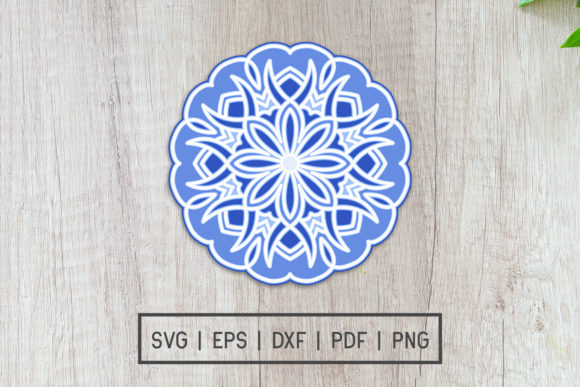
Understanding 3D Mandala Design: Depth, Precision, and Artistic Evolution
The mandala has long been a symbol of balance, spirituality, and intricate geometry. Traditionally drawn on flat surfaces, the mandala has undergone a dramatic transformation with the rise of digital tools. 3D Mandala Design takes this ancient art form and pushes it into a new dimension—literally. By adding depth, volume, and spatial complexity, artists and designers are reimagining what a mandala can be. Whether used in meditation apps, architectural elements, or product branding, 3D Mandala Design offers a fresh perspective on a timeless motif.
What Defines a 3D Mandala Design
At its core, a 3D Mandala Design is a geometric pattern that extends beyond the flat plane. Instead of simply radiating outward from a central point, the design also moves inward, outward, or around in three-dimensional space. This can be achieved through sculpted layers, extruded shapes, or fully rendered digital models. The result is a composition that feels tangible, almost architectural, as if you could reach out and touch its curves and facets.
Unlike 2D mandalas that rely solely on line work and color contrast, 3D Mandala Design introduces light, shadow, and perspective. These elements create a sense of realism and depth that draws the viewer in. The central point becomes a focal peak or a deeply recessed void, and the repeating patterns wrap around imagined surfaces like spheres, cones, or toruses. This shift from flat to volumetric opens up endless creative possibilities.
Key Structural Characteristics and Qualities
Every 3D Mandala Design shares a few core structural qualities that set it apart from its 2D counterpart. Understanding these can help you appreciate the craft or even start your own project.
Radial Symmetry in Three Axes
Symmetry remains the backbone. However, in 3D, symmetry can be applied along multiple axes—not just the X and Y, but also the Z axis. This means that the design can look balanced from any angle. You might rotate a 3D Mandala Design ninety degrees and still see a perfectly mirrored pattern. Achieving this requires careful planning and often mathematical precision.
Layered Depth and Extrusion
Depth is achieved by extruding certain elements of the pattern outward or recessing them inward. For example, petals might rise from the surface, while geometric voids might cut deep into the core. These layered depths create a tactile quality. When rendered with realistic lighting, each layer casts shadows onto the next, emphasizing the dimensionality of the 3D Mandala Design.
Curved and Contoured Surfaces
While some 3D mandalas remain flat on a single plane, the most striking ones often wrap around curved surfaces. Imagine a mandala projected onto the surface of a sphere or a torus. The patterns distort and flow with the curvature, creating an organic feel. This technique is especially popular in jewelry design and architectural ornamentation, where the 3D Mandala Design must conform to a physical object.
Tools and Techniques for Creating 3D Mandala Designs
Creating a 3D Mandala Design requires a blend of artistic vision and technical skill. Fortunately, modern software makes this more accessible than ever. Artists typically use programs like Blender, Cinema 4D, ZBrush, or Fusion 360. Each tool offers unique advantages for different aspects of the design process.
Parametric Modeling for Precision
Parametric tools, such as those found in Fusion 360 or Grasshopper for Rhino, allow designers to define geometric relationships mathematically. This is ideal for 3D Mandala Design because mandalas are inherently mathematical. You can set up a repeating radial pattern and adjust the number of segments, the height of extrusions, or the curvature of surfaces with simple numerical inputs. The computer handles the repetitive work, leaving you to focus on aesthetics.
Sculpting for Organic Flow
For a more handcrafted feel, sculpting tools in ZBrush or Blender let you push and pull the geometry like digital clay. A 3D Mandala Design created this way often has softer edges and irregular details that make it feel alive. Sculpting is particularly effective when the mandala includes flowing, organic shapes that mimic nature, such as lotus petals or vine-like tendrils.
Rendering and Lighting
The final appearance of a 3D Mandala Design depends heavily on rendering. Proper lighting can make or break the depth effect. Designers use multiple light sources—ambient, directional, and point lights—to cast shadows and highlight the contours of the pattern. Materials also matter. A metallic or iridescent finish can make the mandala look futuristic, while a matte texture gives it a grounding, spiritual feel.
Practical Applications Across Industries
3D Mandala Design is not confined to the digital art world. It has found practical use in several industries, each leveraging its unique visual and structural properties.
Architecture and Interior Design
Architects use 3D Mandala Design for decorative screens, ceiling panels, and floor inlays. The radial symmetry creates a sense of harmony in large spaces. Laser-cut metal or wood panels featuring intricate mandala designs are popular in modern buildings. The 3D aspect adds depth so that shadows change throughout the day, making the space feel dynamic. In interior design, a 3D Mandala Design can be the centerpiece of a room—a carved wall panel or a sculptural light fixture.
Jewelry and Product Design
Rings, pendants, and earrings often incorporate mandala patterns. With 3D modeling, designers can create complex, interlocking shapes that would be impossible to hand-carve. A 3D Mandala Design in jewelry allows for hollow structures, filigree details, and stone settings that follow the mandala's geometry. The final piece is then 3D-printed in wax and cast in metal, giving designers enormous freedom.
Meditation and Wellness
The meditative quality of mandalas is well known. In digital form, a 3D Mandala Design can be animated to slowly rotate, creating a centering focal point for mindfulness apps or video projections. The added depth makes the mandala feel more immersive. Users can watch the patterns unfold in 3D space, which can deepen the meditative experience. Some wellness centers project animated 3D Mandala Design onto domed ceilings for a calming environment.
Branding and Visual Identity
Companies in the wellness, luxury, and spirituality sectors use 3D Mandala Design in their branding. A 3D rendered mandala can be an animated logo, a pattern on product packaging, or a background element on a website. The depth and precision convey a sense of quality and attention to detail. Unlike a flat logo, a 3D Mandala Design logo feels modern and multifaceted, suggesting complexity beneath the surface.
Benefits for Artists and Designers
Adopting 3D Mandala Design into your workflow offers several practical benefits. First, it pushes your creative boundaries. Designing in three dimensions forces you to think about form, space, and light in ways that 2D work does not. You begin to consider how a pattern looks from above, below, and every angle in between.
Second, the output is highly versatile. A single 3D Mandala Design can be rendered as a still image, animated in a video, exported as a 3D model for printing, or used as a virtual reality environment. This adaptability means that one design project can serve multiple purposes, saving time and resources.
Third, it opens up new revenue streams. You can sell 3D models on marketplaces, offer custom designs for clients, or create printable files for makers. The demand for high-quality 3D Mandala Design assets is growing as more industries embrace 3D technology. Early adopters have a significant advantage.
Factors to Consider Before Starting a 3D Mandala Project
3D Mandala Design is rewarding, but it comes with a learning curve. Before diving in, consider a few key factors.
Software Choice and Skill Level
Not all 3D software is created equal for mandala work. If you are new to 3D, start with Blender. It is free, has a large community, and offers both modeling and sculpting tools. For precision work, parametric software is better but requires understanding of mathematical constraints. Be honest about your skill level and choose a tool that matches.
Computational Resources
Complex 3D Mandala Design files can become very large, especially with high polygon counts and detailed textures. A decent computer with a good GPU is essential. Rendering times can also be long, so plan accordingly. Cloud rendering services are an option if your local machine struggles.
Intended Use Case
Define the purpose of your design upfront. A 3D Mandala Design for a 3D-printed ring requires different geometry than one for an animated meditation video. For physical objects, you must ensure that the design has no floating parts and that thicknesses are printable. For digital use, polygon count and texture resolution matter more. Align your design decisions with the final output.
Integrating 3D Mandala Design into Modern Workflows
As digital art and manufacturing converge, 3D Mandala Design fits naturally into modern creative pipelines. Artists can design a mandala, render it for social media, then export the same file for CNC milling or 3D printing. This cross-platform utility makes it a smart investment of creative energy.
Collaboration is also easier. You can share a 3D Mandala Design file with a client for review, allowing them to rotate and inspect it in a browser-based viewer. This reduces misunderstandings and speeds up approvals. In a remote work environment, being able to collaborate on a 3D asset in real time is a huge advantage.
Moreover, generative design techniques are increasingly being applied to 3D Mandala Design. Using algorithms, you can create thousands of variations of a single pattern, exploring symmetry and scale in ways that would be tedious to do manually. These generative workflows are becoming standard in modern design studios, and mandalas are a perfect testbed for experimentation.
Tips for Getting Started
- Start simple. Do not attempt a highly complex 3D Mandala Design on your first try. Focus on mastering extrusion and symmetry tools with a basic pattern.
- Study 2D patterns first. Understanding how radial symmetry works in two dimensions will make the transition to 3D much smoother.
- Use reference images. Many classic mandala designs can be imported into 3D software as background images, allowing you to trace and extrude them.
- Experiment with materials. A 3D Mandala Design looks dramatically different in gold, glass, or wood. Play with materials to discover new visual possibilities.
- Share your work. Post your designs in online communities dedicated to 3D art. Feedback can help you improve your technique and discover new applications for your work.
3D Mandala Design is more than a trend. It is a natural evolution of an ancient symbol, adapted for a world that values depth, dimension, and interactivity. Whether you are an artist looking to expand your portfolio, a designer exploring new aesthetics, or a maker wanting to create physical objects with intricate detail, this field offers rich opportunities. The blend of creativity and technical challenge makes every project a journey into balance, symmetry, and space.